Unexpected Genius: Neo-classical Furniture of Norfolk, Virginia: 1780-1820
Sumpter T Priddy, Alexandria, VA
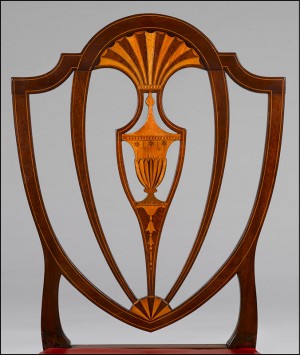
Detail of a Side chair, Norfolk, Virginia, 1795. Private Collection.

Detail of a Demi-lune card table, Norfolk, Virginia, 1795. Private Collection.

Detail of Secretary bookcase, Norfolk, Virginia, 1795-1805. Private Collection
Despite the horrific fires and destruction during the American Revolution, Norfolk’s cabinetmaking trade witnessed a measured revival during the mid 1780s; by the 1790s cabinetmaking began, once again, to bloom. Locally born cabinetmakers, who had practiced the trade prior to the Revolution, were now joined by émigré artisans from Britain and together they spurred development of a full-blown Neoclassical aesthetic that competed with the finest examples from New York and Philadelphia.
Yet Norfolk’s flourishing trade soon fell prey to another invader, this time an outbreak of malaria that devastated the ranks of those who remained and sadly left behind only a shadow of the former trade. Nevertheless, this paved the way for a brilliant young cabinetmaker from the nearby town of Suffolk to quickly move to the forefront among Norfolk’s remaining artisans. Born to a prosperous family of seafarers and merchants, James Woodward was likely “seasoned” to malaria by living his childhood near swamps, which rendered him immune to the disease as an adult. He was likewise blessed with an accomplished family, financial security, a brilliant sense of design, and a long, healthy life. All of these helped him build a thriving business supporting eight workstations for apprentices and journeyman cabinetmakers. He dominated the lower Chesapeake trade through the 1830s and produced some of the most brilliantly veneered and highly carved furniture of the regional school.
As a product of a mercantile family, Woodward, like many of his forebears, invested in shipping; he owned a streamlined sloop that carried his goods up the James River to the new capital city of Richmond, across the Chesapeake to Maryland, and along the Atlantic coastline to the Carolinas. Of Virginia’s Neoclassical cabinetmakers, none dominated the market longer, nor produced a larger group of beautifully carved and veneered furniture, than James Woodward, during his long 45-year career.
Our June speaker, Sumpter T. Priddy III, holds a bachelor’s degree in the History of Architecture from the University of Virginia and a master’s from the Winterthur Program in Early American Culture. He served six years as curator for the Colonial Williamsburg Foundation and tutored for the Historic Deerfield Summer Fellowship Program. Long intrigued by the relationship between architecture, history and the decorative arts, Mr. Priddy is one of the most active researchers in the field. His rediscovery of numerous artisans whose work shaped taste in early America has contributed significantly to a larger understanding of the complexity of regional style. Recent research includes the careers and the products of craftsmen who came from around the globe to Washington, D.C. during the Federal period.
Sumpter Priddy’s rich, fully illustrated, and wondrously researched 2004 book American Fancy: Exuberance in the Arts 1890–1840 received the Historic New England Book Prize for its “significant contribution to the study of American and New England Culture.”
He has contributed articles to The Magazine Antiques and the Chipstone Foundation’s American Furniture, has served as consultant to numerous publications and is the recipient of numerous honors and prestigious awards. He has spoken to the Forum several times since 1995.