A Shopping Spree, an Auction and a Gift: Rediscovering the Furnishings of Mount Vernon’s Front Parlor
Adam T. Erby, George Washington's Mount Vernon

The Upper End of a Drawing Room, attributed to William Gomm, 1761 (Image courtesy, Joseph Downs Collection, Winterthur Museum)
In September 2013, Mount Vernon curators made an exciting discovery; a previously unknown ledger kept by George Washington’s friend and neighbor, George William Fairfax, appeared at auction. At first glance, the ledger seemed to have little to do with Mount Vernon, but as curators mined the document they discovered that much of the London-made furniture listed in the ledger came to Mount Vernon, either by purchase or gift, when its original owner returned to England at the outbreak of the American Revolution. As almost all of the furniture has since disappeared, the document has proven to be a Rosetta Stone for understanding the furnishing of Mount Vernon, demonstrating George Washington’s desire for English goods even as he prepared to take up arms against the mother country.
Adam Erby’s lecture will trace the fascinating tale of these furnishings from the London warerooms of William Gomm and Son to the grand, but now lost, Virginia plantation of George William Fairfax and his wife Sally, and finally to the principal rooms at Mount Vernon. The talk will demonstrate that as these furnishings moved from place to place through retail purchase, auction and gift, they served as a powerful means of establishing Fairfax, and later Washington, as a sophisticated grandee on the edges of empire.
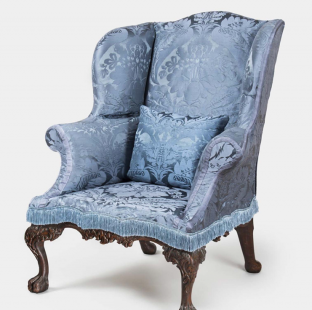
The lecture will focus on the most important find from the ledger, the rediscovery of the furnishings of Mount Vernon’s front parlor. The luxurious suite of eight backstools and a sofa, all covered en suite in rich silk and worsted wool damask, was originally intended for use in George William Fairfax’s dressing chamber. Fairfax later presented that suite to Washington as a gift and memento of their friendship, and Washington redecorated his parlor to accommodate the new furniture upon his return from the Revolution. Washington’s redecoration of the parlor coincided with the addition of his neoclassical “New Room,” transforming the parlor into both one of the most formal rooms in the house and a grand entrance for the new dining and entertaining room. Utilizing comparable examples from British institutions, Mount Vernon curators are currently working with Colonial Williamsburg craftsmen to recreate the extraordinary Fairfax suite. At this lecture, Mr. Erby will use artistic renderings and images of the recreated furnishings to debut the most recent ppearance of the reinterpreted space.
Adam T. Erby serves as the Associate Curator at George Washington’s Mount Vernon. He grew up on his family’s farm in Southside Virginia, where he developed his dual passions for politics and material culture. Learning the thrill of the chase at an early age, Mr. Erby spent much of his time at country auctions and campaigned for a variety of candidates. He received a bachelor’s degree in American Studies from the University of Virginia in 2010 and an masters degree from the Winterthur Program in American Material Culture in 2013, where his thesis explored “Contract and Lawsuits: Building Wakefield Plantation in St. Francisville, Louisiana, 1834–1837.” Mr. Erby’s publications include the essays “Designing the Beautiful: General Washington’s Landscape Improvements, 1784-1787” and “Gardens and Groves: A Landscape Guide” in The General in the Garden: George Washington’s Landscape at Mount Vernon (2014), edited by Susan P. Schoelwer; and “‘The one Mrs. Trist would chuse’: Thomas Jefferson, the Trist Family, and the Monticello Campeachy Chair,” with Sumpter Priddy III and Jenna Huffman in the Chipstone Foundation’s, American Furniture (2012). His article “George Washington’s New Room: An American Vision” appeared in Antiques & Fine Art (Autumn 2014); and “Leaving Home: Butler Greenwood’s Parlor,” with Matthew Thurlow and Alice Dickenson, was published in The Magazine Antiques (March–April 2014).